Signs Your Crawl Space Has a Moisture Problem
- A musty smell that never leaves — especially noticeable when you come home after being away. That smell is mold and mildew activity below your floor.
- Cupping or buckling hardwood floors — wood flooring absorbs moisture rising from below and deforms from the bottom up.
- Sagging or fallen insulation — fiberglass batts soak up crawl space humidity, get heavy, and drop. Wet insulation is useless insulation.
- Condensation on ductwork or pipes — sweating metal in summer means the crawl space air is saturated.
- Standing water or damp soil after rain — drainage or grading is moving water under the house instead of away from it.
- Higher summer cooling bills — humid crawl space air infiltrating the home makes your AC work far harder.
- Allergy symptoms that improve away from home — spores from crawl space mold circulate through the living space.
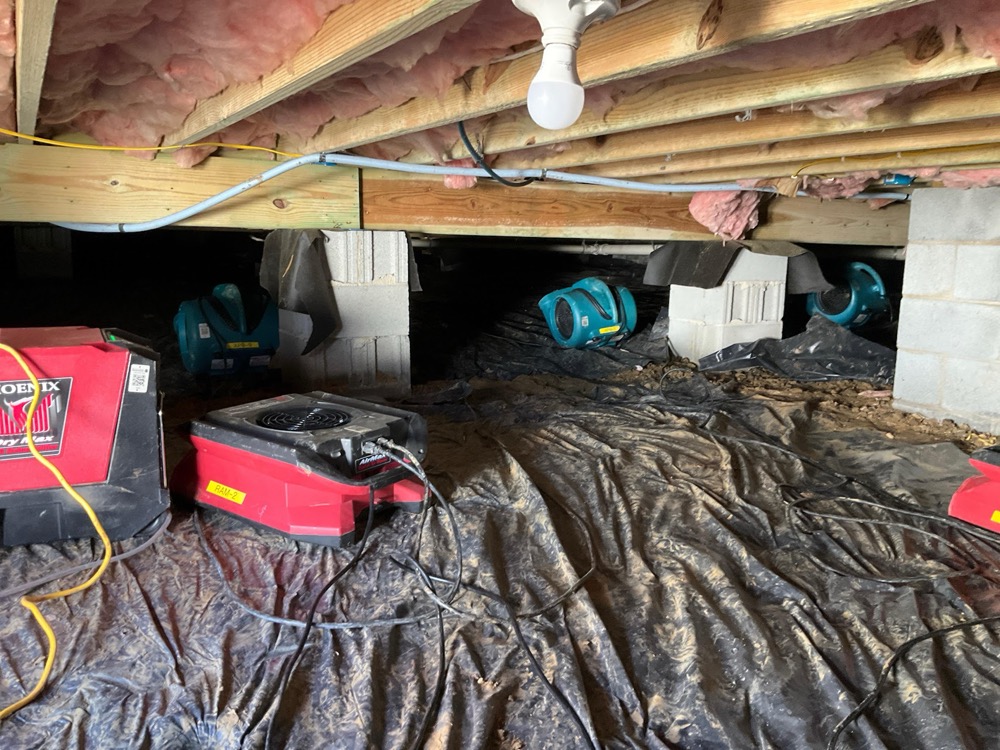
One of our crawl space drying setups — air movers and dehumidification running on a fresh vapor barrier.
What We Do — and What We’ll Tell You Honestly
We are a restoration company, not a foundation contractor — and that shapes how we approach crawl spaces. Our focus is the moisture, the mold, and the damaged materials. Here’s what that covers:
Vapor Barrier Installation
The single highest-impact fix for most Carolina crawl spaces. Bare earth releases gallons of water vapor into your crawl space every day. We install heavy-mil polyethylene vapor barrier across the exposed soil, sealed at seams and turned up at piers and walls, cutting ground moisture off at the source. If an old, torn, or thin builder-grade barrier is in place, we remove it and start clean.
Crawl Space Drying & Structural Assessment
If the crawl space is actively wet — from a plumbing leak, HVAC condensate failure, or storm intrusion — we dry it the same way we dry the rest of a house: commercial dehumidifiers, air movers, and daily moisture readings until the wood framing is back below safe thresholds. We document subfloor and joist moisture content before and after, and we’ll tell you plainly if we see structural decay that needs a repair contractor.
Insulation Removal & Replacement
Moisture-ruined insulation doesn’t recover. We remove wet, sagging, or mold-affected batts, bag them out, and install new insulation once the space is dry — so you’re not paying to heat and cool a house sitting over saturated fiberglass.
Crawl Space Mold Remediation
Mold on floor joists and subfloor is the most common thing we find under Carolina homes. We remediate it to the same IICRC S520 standard we use inside the home: containment, HEPA filtration, removal or treatment of affected surfaces, and verification. See our full mold remediation process — the standards are identical, the workspace is just tighter.
Why Crawl Space Moisture Gets Worse in the Carolinas
Charlotte-area summers combine 90-degree heat with dew points in the 70s. When that outside air vents into a crawl space cooled by the earth, its moisture condenses on every cool surface — joists, ducts, pipes. That’s why vented crawl spaces here often measure 80–90% relative humidity all summer, well above the ~60% threshold where mold growth and wood decay begin. Red clay soil compounds the problem: it drains slowly, holding rain against and under foundations for days after a storm.
This is the same physics that drives our water damage work — moisture goes where the temperature difference sends it. The difference is speed: a burst pipe ruins a floor in hours, while a damp crawl space rots one over years. Both end at the same place if ignored.
Moisture Source First, Always
Laying plastic over a drainage problem is a bandage. Every crawl space project starts with finding out where the water comes from: ground vapor, exterior grading and gutters, a plumbing or condensate leak, or humid summer air condensing below the floor. We identify the source with moisture readings and photos, fix what falls within our scope, and document exactly what needs correcting when it doesn’t — so you fix the cause once instead of treating symptoms forever.
Does Insurance Cover Crawl Space Damage?
It depends on the cause. Sudden events — a burst supply line, a water heater failure, storm water intrusion — are typically covered, including the drying, mold remediation, and insulation replacement that follow. Gradual moisture from ground vapor or poor drainage typically is not. We’ve documented hundreds of claims for Carolina carriers and will give you a straight answer about which side of that line your situation falls on before any work starts — and when it is covered, we bill your carrier directly.
Frequently Asked Questions
How much does a vapor barrier cost?
For most homes in our service area, professional vapor barrier installation runs in the low-to-mid four figures depending on crawl space size, access, and how much old material and debris must be removed first. That’s a fraction of full encapsulation, which commonly runs five figures. We quote a firm price after the free inspection — no estimate ranges that double once someone’s under the house.
Do I need full encapsulation, or is a vapor barrier enough?
For most moisture problems we see, a sealed vapor barrier plus a corrected water source solves the problem. Full encapsulation — sealed walls and vents with a dedicated dehumidifier — earns its cost mainly in homes with severe humidity issues, HVAC in the crawl space, or persistent condensation that ground-vapor control alone can’t fix. We don’t sell encapsulation, so our recommendation isn’t a sales pitch: if you need it, we’ll say so.
There’s mold on my floor joists. Is my house structurally at risk?
Surface mold on joists is common and remediable — it becomes structural only after prolonged moisture keeps wood above roughly 28% moisture content long enough for decay fungi (wood rot, which is different from surface mold) to soften the wood. During inspection we probe suspect framing and give you an honest read: most crawl spaces we see need remediation and moisture control, not structural repair. When we do find rot, we document it clearly so a repair contractor can price it without guesswork.
How long does crawl space work take?
Vapor barrier installation is typically a one-day job. Add drying time (2–4 days of equipment run-time) if the space is wet, and 1–2 days for mold remediation and insulation replacement on larger projects. Most complete crawl space moisture projects finish within a week, and you don’t need to leave home for any of it.
Not sure what you’re smelling or seeing? Read our guide: Why Carolina Crawl Spaces Stay Damp — Signs, Causes, and What Actually Fixes It. Or snap a photo and ask our AI assistant right on this page — it’s free and it’ll give you a straight answer in seconds.